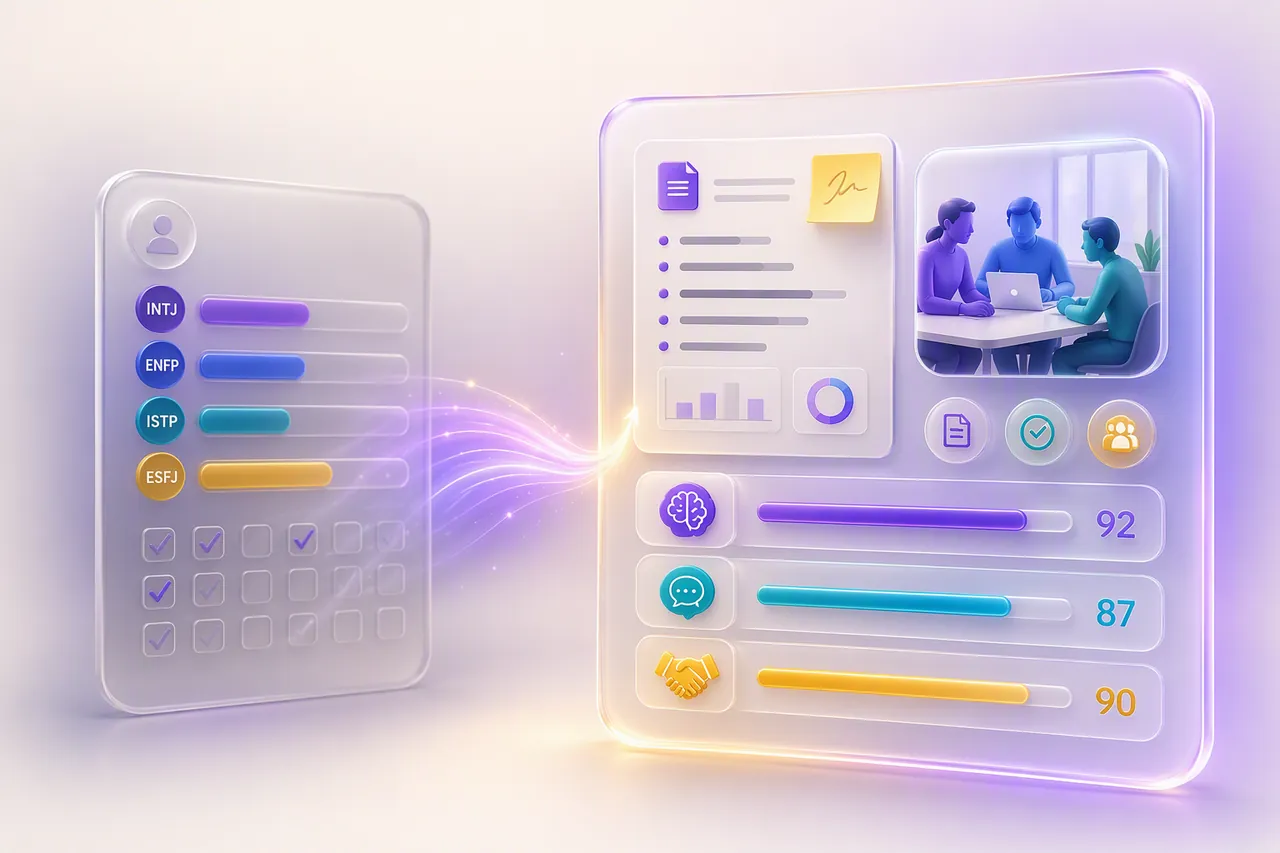
Hiring after AI
why candidates and recruiters keep automating each other
By WiseWorld

Why do candidates and recruiters keep automating each other? Application volume roughly tripled since 2021. Candidates automate to cut rejection pain; recruiters automate to survive identical CVs. Each side's tools push the other to respond in kind.
More screening of the same pile does not show how people use soft skills as they do the job. See our guide to assessing candidates after AI resume screening for what to run after qualification.
Introduction
Applications per hire roughly tripled since 2021 (Ashby, 2026). Candidates answer with ChatGPT and auto-apply bots. Recruiters answer with resume rankers and interview bots. Under that surface is something older: two groups trying to manage uncertainty, rejection, and overload in a market that got louder at the same time it got less transparent.
Both sides turned to AI for rational reasons. Candidates cut rejection pain and the effort of hitting apply. Recruiters survived hundreds of near-identical CVs per role. Each side's tools push the other to respond in kind.
For what to run after qualification, see our guide to assess candidates after AI resume screening.
Hiring after AI: headline statistics
Key numbers on application volume, initiation lift, AI interview dropout, and interview stress.
- 3×: Applications per hire vs 2021 (Ashby 2026)
- 600%: More applications when applying got easier (Field 2023)
- 38%: Candidates who left when AI interview was required (Greenhouse 2026)
- 70–80%: People stressed in mock job-interview lab tests
Why do candidates and recruiters keep automating each other?
Application volume roughly tripled since 2021. Candidates automate to cut rejection pain and the effort of starting each application. Recruiters automate to survive hundreds of near-identical CVs per role. Each side's tools push the other to respond in kind: a rational loop that destroys the signal both sides actually want.
In this article
Table of contents for the hiring after AI arms race guide.
- Why did both sides turn to AI?
- What does job hunting do to candidates?
- What does the application pile do to recruiters?
- Why do candidates resist AI hiring tools?
- Why does the arms race keep spinning?
- What should recruiters do after qualification?
- What can recruiters and candidates do next?
Key findings on hiring after AI
Summary of what the charts and sections in this guide show.
- AI use is rational on both sides: candidates face rejection and slow feedback; recruiters face about 3x application volume since 2021.
- Interviews and recorded AI video screens trigger the same stress responses lab studies link to being judged with little control.
- Rejection from a person hurts more than rejection from software; silence after applying hurts both sides.
- Both sides want to be seen as individuals, feel they can influence outcomes, and know a real person is involved.
Root causes: why both sides turned to AI
AI did not start this problem. Both sides were already under pressure, and AI just gave them a faster way to cope. Candidates deal with a process that rarely explains itself, rejects most people, and feels draining every time they apply. Recruiters deal with application counts that tripled since 2021 and hundreds of near-identical CVs for a single role.
Why candidates lean on AI. Most people apply to fewer jobs than you would expect, and the reason is not laziness. Field et al. (2023) and Garlick et al. (2023) found the hard part is simply getting started: hitting apply feels costly. In one experiment, a small nudge raised the number of applications by about 600%, and those extra applicants still got interviews at a similar rate. The barrier was effort, not ability. AI resume and auto-apply tools remove that effort, so people use them.
Why recruiters lean on AI. Today it takes about 291 applications to make one hire, up from around 100 in early 2021 (Ashby, 2026). Every CV is one more quick judgment call under time pressure. Jessup et al. (2019) found that when the pile gets too big, people actually make fewer good decisions, not more. Automation is the natural way to cope, even though it creates new problems later on.
Why candidates and recruiters lean on AI
How often each reason shows up across studies. Higher means it comes up more; not from a single survey.
- Candidate: Rarely hear back after applying: 72
- Candidate: It feels hard to start each application: 68
- Candidate: Fear of rejection and dwelling on silence: 64
- Candidate: Not enough time to apply: 58
- Candidate: Pressure to keep up with polished AI CVs: 55
- Recruiter: About 3x more applications per hire since 2021: 78
- Recruiter: Too many quick judgment calls under time pressure: 71
- Recruiter: Protecting the hiring manager's time: 65
- Recruiter: Spotting AI-written or exaggerated CVs: 45
- Recruiter: Judging every candidate by the same standard: 54
Both sides make sense
Candidates reduce friction and rejection pain in an opaque market. Recruiters manage overload that tripled application volume. Document automation on both sides destroys the signal both sides actually want.
What job hunting does to candidates
Job hunting is stressful for a simple reason: other people are judging you, and you cannot control what they decide. A large review of 208 lab studies found that stress hormones spike most when those two things happen together, being judged and having no control over the result (Dickerson and Kemeny, 2004). A job interview is almost a perfect example. Researchers use a fake job interview as a standard way to trigger stress in the lab, and it works on about 70 to 80% of people (Kudielka et al., 2007).
Rejection hurts more when it feels personal. In one study, people who were turned down by a human recruiter kept replaying it in their heads and blamed themselves more than people who were turned down by software. That kind of dwelling and self-blame is tied to anxiety and low mood, and it makes applying to the next job feel even harder.
Three candidate habits follow from that stress:
- Applying to more jobs to feel in control. When no one replies, sending out more applications (often with bots) at least feels like doing something.
- Polishing CVs to feel safe. About 70% of job seekers now use AI on their applications (Indeed Hiring Lab, 2025 to 2026), because a polished CV feels safer when you cannot tell what recruiters want.
- Over-preparing to feel protected. Interview-coaching content is booming because live interviews are the most nerve-racking part.
Post-GenAI trust on the candidate side
Indeed Hiring Lab and Greenhouse employer surveys, 2025–2026.
- Job seekers using GenAI on applications: 70%
- Recruiters who distrust resume-only screening: 67%
- Employers adding skills tests after AI resume flood: 54%
- Candidates who say AI makes applying easier: 58%
Rejection from a person stings more than rejection from software
How much more candidates dwell on it and blame themselves when a human says no, compared with being turned down by an algorithm (OSF study, 2025).
- Keeps replaying the rejection: Cohen's d 0.51 vs algorithmic baseline
- Blames themselves: Cohen's d 0.46 vs algorithmic baseline
Make applying easier and people apply far more
Field et al. (2023): a small nudge from a recruiter raised applications about sixfold. Plain job alert indexed to 100 for comparison.
- Just a job alert: 100
- Job alert plus a quick nudge to apply: 600
What the application pile does to recruiters
Recruiters feel the stress too, just from the other side. When hundreds of CVs arrive for one role, screening turns into the same yes-or-no call over and over, with almost no feedback on whether those calls were right. After enough of those, people get tired. Accuracy slips, patience drops, and everything starts to look the same. That is decision fatigue (talent-acquisition workload studies, 2025 to 2026).
Jessup et al. (2019) ran a hiring simulation. People given a large stack of applicants under time pressure were less likely to hire anyone at all than people given a small stack. Overwhelm did not make them pick better. It made them freeze or put the decision off. That matches what recruiters describe in real life: inbox paralysis, skimming each CV less carefully, and saying "we'll come back to the pile later."
The numbers explain why. Applications per hire have roughly tripled since 2021, and in 2025 the average sat above 300 (Ashby, 2026). LinkedIn data reported in The New York Times showed 45%+ year-over-year growth in applications, peaking around 11,000 submissions a minute. More CVs do not mean more clear-cut candidates. They often mean more similar-looking documents.
Application volume on the recruiter side
Ashby 2026, NYT 2025, and recruiter productivity benchmarks.
- 300+: Applications per hire on average in 2025
- 291: Applications processed per hire per recruiter today
- 45%+: LinkedIn application growth YoY (NYT 2025)
Choice overload under time pressure
Jessup et al. (2019): recruiters in a hiring simulation were less likely to hire from large applicant sets when time was limited. More AI-generated CVs can push teams toward reject-all behavior or thinner heuristics, not better matches.
When recruiters automate, and candidates resist
Employers responded with their own AI: parsers, rankers, recorded video interviews, chat interviewers. Surveys show ~45% of talent acquisition (TA) leaders cite detecting GenAI applications as a stack-change driver (employer surveys, 2025–2026). Greenhouse (2026) reports 38% of applicants withdrew when an AI interview was required. They walked away rather than complete the step. For vendor-level context on one-way video and replacement options, see our HireVue alternative guide.
That tension shows up in fairness research. Newman et al. (2020) found applicants perceive pure algorithm-driven selection as less fair than human or human-assisted processes, even when outcomes favor them. A proposed mechanism: belief that algorithms cannot recognize individual uniqueness, a basic social need (Brewer, 1991). Langer et al. (2022) reviewed fairness perceptions across algorithmic tools and found repeated deficits in behavioral control (feeling you can influence the outcome) and social presence (empathy, interpersonal warmth).
Why employers changed their screening stack
Share of TA leaders citing each driver (employer surveys, 2025–2026).
- Verify skills beyond the resume: 67%
- Reduce recruiter phone screen load: 61%
- Detect AI-generated applications: 45%
Candidates trust humans more than software
Each block asks the same question twice: human-led vs software-led screen. Higher bar = more candidates said yes. Newman et al. (2020) and Langer et al. (2022).
- Can I affect what happens next? Human: 72. Software: 38.
- Does someone at the company seem to be listening? Human: 78. Software: 34.
- Does the process feel fair? Human: 70. Software: 48.
AI vs AI is rational, and exhausting
Candidates automate to reduce initiation cost and rejection pain. Recruiters automate to survive volume and decision fatigue. Neither side gets more control, clarity, or a fair chance to be seen as an individual.
Recruiters show their own form of algorithm aversion after visible mistakes, preferring manual review even when automation outperforms on average (Dietvorst et al., 2015; HR extension in Frontiers in Psychology, 2022). Both sides distrust black boxes. The arms race is rational; it is also emotionally expensive.
Why the loop keeps spinning
The cycle repeats:
- Candidate: the process feels opaque and rejection hurts → stress builds → AI makes applying easier → more applications go out.
- Recruiter: more applications arrive → overload sets in → AI filters the pile → candidates get less feedback → candidate stress rises again.
The turning point is how each hiring step feels. Interviews and tests always involve being judged. What matters is whether the step gives candidates two things: a sense that they can influence the outcome, and a sense that a real person is involved. Pre-recorded AI video interviews often remove both. A structured job scenario, with clear criteria and a human who reviews the result, can keep both.
How stressful each hiring step tends to feel for candidates
Social-evaluative threat by hiring touchpoint.
- Resume screen (silent rejection). Stress: Lower stress, more uncertainty. You often never learn why you were rejected.
- Recorded video interview (AI-scored). Stress: High stress. You are judged, with little control and no human contact.
- Live hiring manager interview. Stress: Very high stress. Same kind of pressure lab studies use to trigger stress responses.
- Job-built scenario (structured). Stress: Moderate stress. Still evaluative, but tied to the role with clear criteria.
Psychology and neuroscience sources used in this article
Research findings on stress, rejection, choice overload, and algorithm fairness.
- Social-evaluative threat + uncontrollable performance tasks produce the largest cortisol responses in laboratory stress research. Source: Dickerson & Kemeny, 2004, Psychological Bulletin meta-analysis
- Mock job-interview stressors (TSST) activate HPA-axis cortisol in ~70–80% of participants. Source: Kudielka et al., 2007; Allen et al., 2014
- Human recruiter rejection increases rumination and self-blame vs algorithmic rejection (medium effect sizes). Source: Rejection vignette study (OSF, 2025)
- Lowering the psychological cost of initiating applications can increase submissions ~6× with similar interview yield per application. Source: Field et al. / Garlick et al., 2023
- Choice overload in hiring simulations: larger applicant sets + time pressure → fewer hires (deferral / reject-all). Source: Jessup et al., 2019; APA summary of Jessup et al., 2019
- Applicants perceive pure algorithm-driven selection as less fair; uniqueness recognition is a proposed mechanism. Source: Newman et al., 2020
- Algorithmic tools score lower on behavioral control and social presence, two procedural-fairness facets. Source: Langer et al., 2022
We are not saying every recruiter or candidate is in crisis. GenAI hiring keeps triggering the same stress responses researchers have measured in labs for decades, now across the whole market.
Valid needs: what each side is actually asking for
Recruiters and candidates describe the same frustration from opposite sides
What each side says they want from the hiring process.
- Recruiters want a CV that reflects the person; candidates want not another robotic screen.
- Recruiters want an interview where you know who you're talking to; candidates want a real human from the company.
- Recruiters want a test that shows how someone thinks; candidates want someone they might actually work with.
Recruiters and candidates name the same frustrations from opposite sides. Same three needs:
- Identity visibility, "see me as a person, not a template."
- Behavioral control, "let me influence the outcome with what I do, not only what I wrote."
- Social presence, "someone real represents the company and explains what happens next."
Willo Hiring Trends (2026) puts behavioral interviews with real examples at the top of what recruiters trust (68%). Candidates complete realistic work tasks at ~83% vs ~68% for AI interviewers (Candidate Voice Report, 2026). Both sides lean toward performance evidence when the task feels job-related and humans remain accountable for decisions.
Two funnels, one collision point
Recruiters and candidates run parallel funnels. They collide hardest after qualification, the unnamed Stage 4 step our six-gaps research documents, where volume, weak signal, and prep risk stack up.
Candidate and recruiter funnels side by side
Psychological load and cognitive load by stage, and where AI concentrates.
- Candidate Discover role: Hope + competition anxiety. AI: AI job alerts, auto-apply lists.
- Candidate Tailor & submit: Initiation cost; loss aversion. AI: ChatGPT CVs, bots, mass apply.
- Candidate Screen / assessment: Social-evaluative threat. AI: AI interview prep content.
- Candidate Human interview: Peak SET; rumination if rejected. AI: STAR coaching, scripted answers.
- Candidate Offer / silence: Rejection sensitivity; self-blame. AI: Ghosting amplifies rumination.
- Recruiter Intake & post: Define criteria; often vague soft skills. AI: JD tools, template libraries.
- Recruiter Inbound volume: Sorting overload. AI: AI parsers, knock-out questions.
- Recruiter Stage 4 screen: Micro-decisions × hundreds. AI: Phone screens, tests, recorded video interviews.
- Recruiter Manager interview: Calibration drift; fatigue. AI: Multiple rounds, weak signal handoff.
- Recruiter Offer & close: Time pressure; sunk cost. AI: Rush to fill vs quality tension.
On the candidate side, the highest initiation cost and lowest control sit at apply and silent screen. Auto-apply and CV polish concentrate there.
On the recruiter side, the highest cognitive load sits at inbound sort and Stage 4 micro-decisions. Parsers and bot screens concentrate there.
Redesigning only one funnel while ignoring the other tends to bounce the stress back. More filters push candidates toward more volume; more volume pushes recruiters toward more filters.
What should recruiters do after qualification?
What should recruiters do after qualification? Break the document arms race. After the resume screen, see how they use soft skills as they do the job.
What should recruiters do after qualification?
Break the document arms race. After the resume screen, see how they use soft skills as they do the job. See the guide to assess candidates after AI resume screening for market data, evidence tables, and a five-step workflow.
Breaking the loop (recruiter-side evidence path)
Three steps to shift from document automation to seeing how they use the skills in the work.
- Qualify on resume, then stop treating it as proof.
- See how they use all 44 soft skills as they do the job, before the manager interview.
- Rank on observed actions; keep a human accountable for who advances.
What we can do, and what we still do not know
For recruiters (evidence-aligned):
- Name Stage 4. Write what happens between qualified and manager interview; measure cost and completion.
- See the skills in the work. Identical resumes do not show how someone uses soft skills. After qualify, score all 44 in the job (write, create, hand off), not another questionnaire.
- Protect fairness facets. Publish what is assessed, who sees it, and how candidates can show job-relevant skill. A human reads the evidence.
- Close the loop on rejection. Human rejection hurts more than algorithmic silence; either way, opaque outcomes fuel rumination.
For candidates (honest, not preachy):
- Separate volume from fit. Auto-apply may reduce initiation cost but can increase silent rejection load.
- Invest in the work step. Where employers let you do a slice of the job, finishing is a stronger signal than another polished PDF.
- Ask process questions. Who reviews? What is scored? Is a human in the loop? Newman et al. (2020) and Langer et al. (2022) flag the same fairness facets.
Open questions, no consensus answer yet
Unresolved questions for recruiters and candidates.
- Recruiter: At what application volume does another AI filter reduce quality more than it saves time?
- Recruiter: When should a human review every Stage-4 rejection vs batch silence?
- Recruiter: Can your team name three behaviors the resume screen actually measures for this role?
- Candidate: Which steps in your search are driven by anxiety vs information about fit?
- Candidate: After a rejection, do you know whether a human or an algorithm made the call?
- Candidate: Would you trade one generic auto-apply for work from the actual job you can finish in 30 minutes?
WiseWorld's take: design for threat, control, and presence
The arms race eases when you see how they use soft skills as they do the job, with clear criteria, human review, and evidence managers can trust: one link from your job description, ranked shortlist, before the manager interview.
Methodology
Synthesis piece; no new primary dataset. We combine hiring-market statistics with peer-reviewed psychology, neuroscience, and behavioral-economics sources. Indexed bar charts labeled "literature synthesis" compare fairness facets across human vs algorithmic assessment; they are illustrative indices, not new survey data.
- Market volume: Ashby 2026 Talent Trends (109M+ applications, 247K jobs); NYT / LinkedIn 2025 application growth.
- GenAI adoption: Indeed Hiring Lab, 2025; Greenhouse 2026 Candidate AI Interview Report.
- Stress research: Dickerson & Kemeny, 2004; Kudielka et al., 2007; Allen et al., 2014.
- Rejection & regulation: Job-application rejection vignette study (OSF, 2025).
- Search effort: Field et al. / Garlick et al., 2023 (J-PAL WP4478).
- Choice overload: Jessup et al., 2019, Decision; APA summary.
- Algorithm fairness: Newman et al., 2020; Langer et al., 2022.
- Completion & trust: Candidate Voice Report, 2026; Willo Hiring Trends, 2026.
- Cluster: assess candidates after AI resume screening; R3 six gaps; phone screen vs self-paced screening; R2 cheat-proof.
We interpret; we do not claim causation from cross-sectional surveys. Where vendors disagree, we cite the published number and note the limit.
External sources and related WiseWorld articles
Market data, psychology research, and related recruitment guides cited in this article.
- Market data: Ashby, 2026 Talent Trends; The New York Times, 2025
- Psychology: Dickerson & Kemeny, 2004; Rejection vignette study (OSF, 2025)
- How to assess candidates after AI resume screening
- Phone screen vs self-paced screening
- Six hiring funnel gaps research
- Pre-interview behavioral assessment guide
- Cheat-proof soft skills assessment research
More in Recruitment

Latest on the blog