Are personality tests accurate for hiring?
What the data shows
By WiseWorld
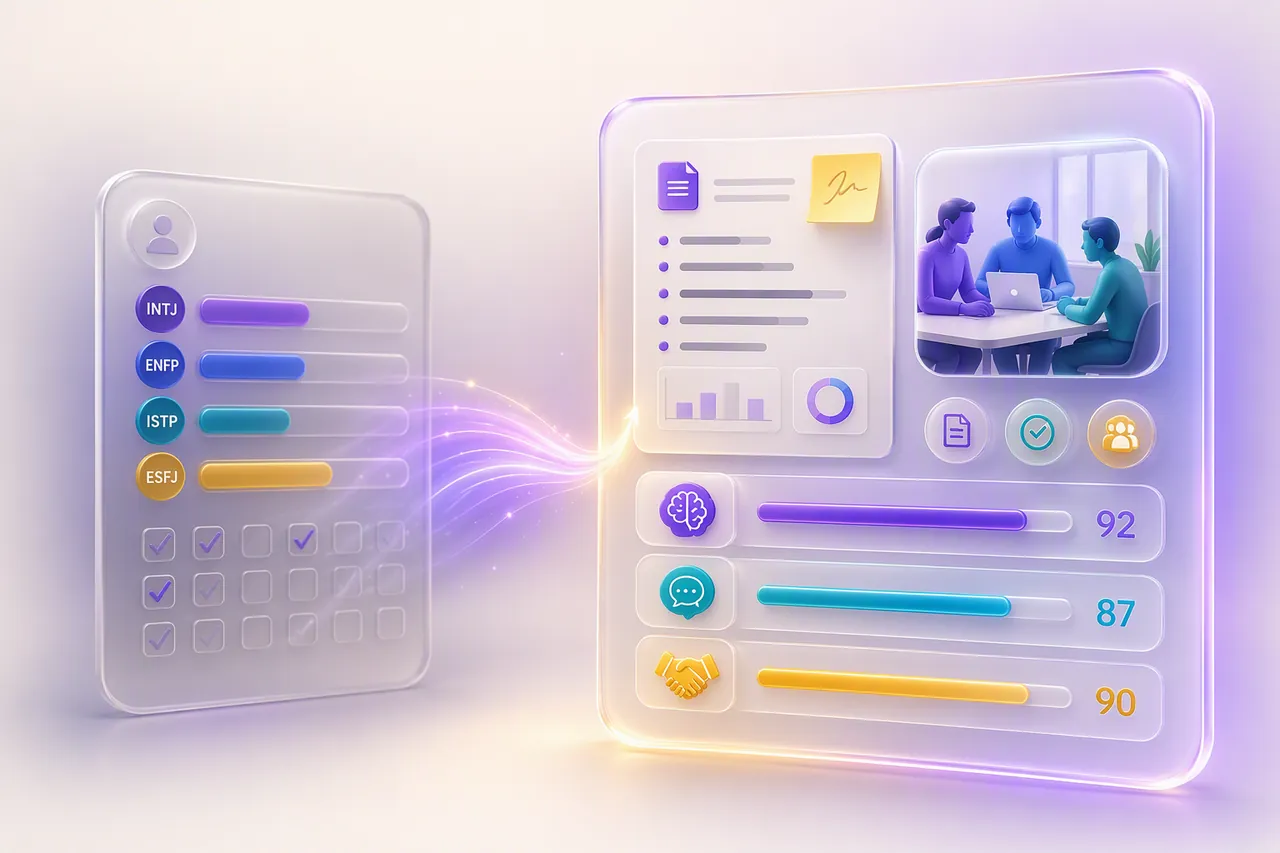
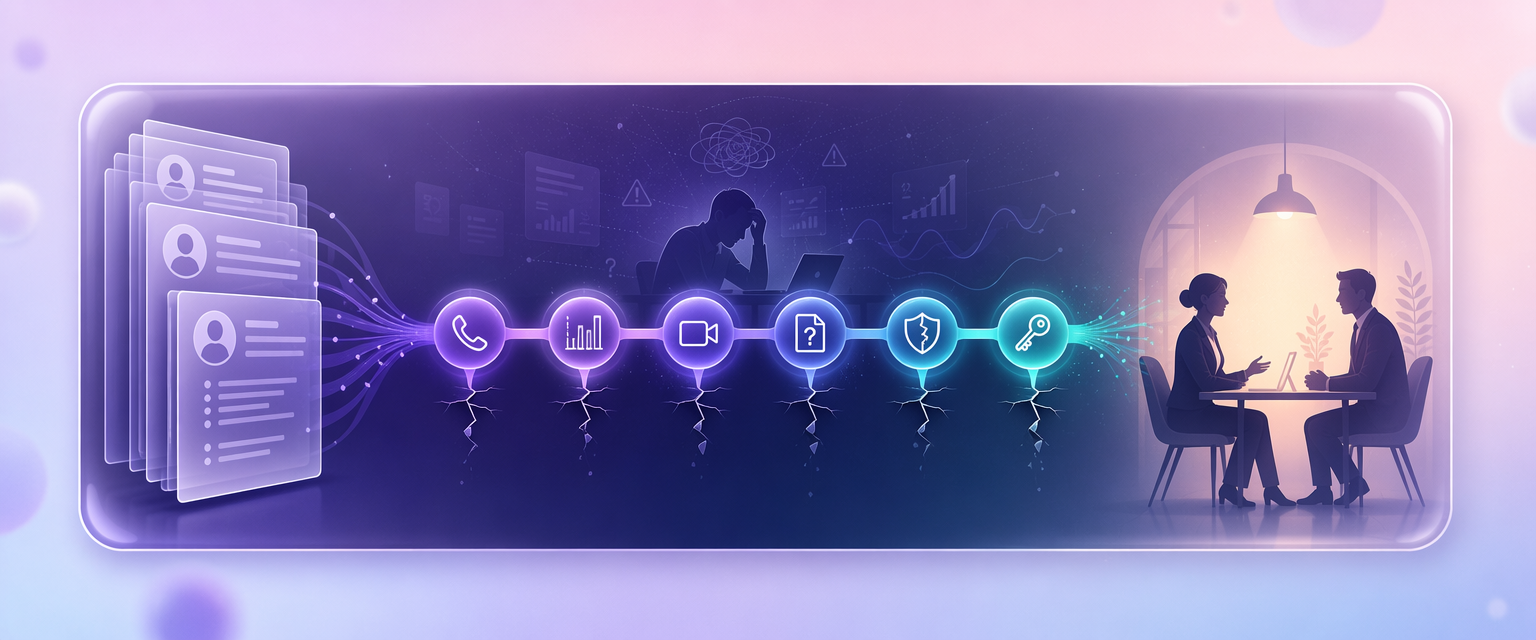
What is a personality test alternative for hiring? See how people use soft skills as they do the job, not a quiz about who they say they are. Personality inventories sit near the bottom of hiring research, tied with unstructured chats. The interview can stay. The questionnaire can go.
Introduction
A hiring manager once showed me a personality PDF like it was a blood test. High dominance. Low patience. 'Not a culture fit.' The candidate had never done a minute of the actual job in front of anyone.
The sell is speed. Most inventories finish in about six minutes and return bars, types, and a PDF for the debrief. You do not get writing from the role, a handoff under pressure, or anything two finalists could be ranked on.
Personality tests in hiring: headline statistics
Quizzes barely predict the job (19/100), one in three employers still use them for managers, and applicants inflate wanted traits by about 45%.
- 19/100: How well personality quiz scores predict who will do well on the job (Sackett et al., 2022)
- 1 in 3: US employers still screen managers with a personality or behavior test (SHRM)
- +45%: How much applicants score higher on traits employers want vs people not applying (Birkeland et al., 2006)
What is a personality test alternative for hiring?
Use a tool that shows how people use soft skills as they do the job, not a quiz about who they say they are. Structured interviews, job simulations, and work from the role all beat a trait questionnaire. The interview can stay. The questionnaire can go.
In this article: personality test alternative sections
Question-based headings for each section of the post.
- Where did personality tests in hiring start, and why?
- How did they develop, and why are they outdated?
- What does psychology research say goes wrong?
- Why do companies still use them?
- What do candidates and recruiters say?
- What did AI change?
- Where do they sit in the recruiting journey?
- What is a personality test alternative for hiring?
- What is missing, and what works instead?
- Books, podcasts, and videos
Where did personality tests in hiring start, and why?
They started because nobody had time to know people. In 1917 the US Army needed to screen huge numbers of recruits. The first widely copied tool was a yes/no checklist about nerves and sleep. It was a wartime filter, not a theory of who would be good at a job.
Hiring copied the same shortcut. You have 400 applicants and eight interview slots. A questionnaire feels like a fair way to cut the pile without booking 400 calls. That is the honest origin story. Scale first. Signal second.
In 1943 a mother-and-daughter team published the Myers-Briggs Type Indicator (MBTI), still the best-known type quiz. You answer forced-choice questions and walk out with four letters and a label, like ENFP or ISTJ. Managers can repeat that label in a five-minute debrief. That is why MBTI spread from team workshops into hiring rooms.
At one point 89 of the Fortune 100 had used MBTI. Wide use is not the same as predicting the job. About half of people get a different letter on a short retest. The publisher has long told employers not to use it for selection.
By the 1960s, psychologists who study hiring tools were already warning that personality measures were a poor bet for selection. The tools kept selling anyway. A type is a story. Whether it predicts the job is a different question.
How did they develop, and why are they outdated?
Researchers kept testing whether self-report quizzes predict job performance. The online hiring products mostly stayed the same: quick questions, a PDF, a profile managers can repeat.
In 1991 researchers merged dozens of hiring studies. They asked: do personality quiz scores predict who will do well on the job? The best answer: people who mark themselves organized and reliable had a small link to later performance. People who mark themselves outgoing had a small link in sales and management roles. Small enough that you would still want interviews and work from the role. Predictive Index-style vendors cited the finding in sales decks and kept selling six-minute adjective lists anyway. None of the studies said a web form should replace watching someone write the update, fix the handoff, or handle the messy ticket.
How personality testing moved into hiring
From the 1991 workplace personality meta-analysis through internet inventories, the 2007 debate, and ChatGPT.
- 1991: Workplace personality research pooled. Self-rated organized/reliable links slightly to job performance. Outgoing self-ratings help a little in sales. Vendors sell six-minute quizzes anyway.
- 2000s: Internet inventories at scale. Predictive Index, Caliper, Criteria, SHL OPQ. Six minutes, a PDF, a color profile. Cheap enough for every req.
- 2007: Hiring psychologists push back. A panel titled 'Won't Get Fooled Again' lands in a journal. Validity is still low. Faking is expected.
- 2010s: Games and 'culture fit'. Pymetrics-style games and DISC workshops. Same self-report logic in a friendlier wrapper.
- 2022 to 2026: Sackett revision, then ChatGPT. Validity estimates fall after range-restriction fixes. Generative AI writes the 'ideal employee' in seconds.
The profile is easy to repeat in a debrief. It does not tell you whether someone can calm a delayed shipment thread at 4pm. People are not one type in every room. Someone quiet in a group interview can run a crisp incident review. A quiz flattens that. The job does not.
What does psychology research say goes wrong?
Traits exist. The mistake is using a self-report, under hiring pressure, as if it were a work sample.
What goes wrong when personality quizzes are used to hire
Faking, unstable types, culture matching, and candidate fairness ratings.
- Applicant faking. Conscientiousness +0.45 d, emotional stability +0.44 d vs non-applicants (Birkeland et al., 2006)
- Who gets hired changes. Faking on self-report can reorder the shortlist even when average validity looks 'fine' (Rosse et al., 1998)
- Unstable types. About 50% get a different MBTI letter on a five-week retest (McCarley and Carskadon, 1983 / Pittenger, 2005)
- Culture matching. Elite hiring often rewards similarity ('we'd get a beer') more than skill (Rivera, 2012)
- Candidates like them less. Personality quizzes score 4.34 / 7; real work tasks score 5.04 / 7 (IJSA, 2025)
The row that should bother you is Rosse et al. (1998): faking can reorder who you hire, even when the average validity still looks 'fine.' Lauren Rivera's 2012 study of elite professional hiring found evaluators used cultural similarity (sports, schools, 'we'd get a beer') as a proxy for merit. A personality profile can give that instinct a scientific-looking cover. Extraversion reads as leadership. Susan Cain's Quiet (2012) is the long version of that warning.
Why do companies still use them?
If the validity is weak, why is the PDF still in the process? SHRM (2022) found 56% of employers use some pre-employment assessment. Personality is the module that needs no job analysis and no interviewer training.
Why companies still use personality tests in hiring
Speed, manager PDFs, sunk licenses, legal comfort, and workshop culture.
- Speed: A Predictive Index-style adjective list can finish in about six minutes. A structured interview needs a calendar.
- A chart managers can point at: High dominance. Low formality. The PDF feels like a lab result. Sackett's 0.19 does not print on the cover.
- Already paid for: The vendor is in the HRIS. Renewing is easier than teaching hiring managers a new rubric.
- Sounds defensible: SHRM still lists behavior or personality assessments as a standard technique. 'We used a validated instrument' is a comfortable sentence in a debrief.
- Culture language: Teams use DISC and MBTI in workshops. Using the same labels in hiring feels consistent, even when the publisher says not to.
What do candidates and recruiters say?
We read hiring forums on both sides about personality tests in the stack. Each chart scores how often a theme showed up in posts we read, from 0 to 100. One hundred means that theme appeared in nearly every thread. This is not a poll of all candidates or recruiters.
Candidates focus on fairness and prep:
Candidate complaints about personality tests
Forum posts scored 0 to 100. Complaints about prep, opacity, rejection, labeling, and cheating.
- Picked answers the employer wanted: 86 out of 100
- Never told what was being scored: 78 out of 100
- Rejected without talking to anyone: 74 out of 100
- Felt labeled as a personality type: 69 out of 100
- Looked up how to pass online: 81 out of 100
Coaching sites now publish step-by-step guides for popular adjective quizzes like Predictive Index: which words to pick, which to skip, even ChatGPT prompts that spit out an ideal-employee profile. Candidates pass those links around before they apply. When the how-to-pass page ranks on search, the score tracks prep, not fit.
Recruiters focus on speed, sunk cost, and manager comfort. Several say they do not fully trust the score but send the quiz anyway because they cannot staff another screen:
What recruiters say about personality tests
Forum posts scored 0 to 100. Themes include manager PDFs, sunk licenses, speed, and doubt about prediction.
- Managers like the profile PDF: 82 out of 100
- We already pay for the tool: 77 out of 100
- Faster than another interview: 73 out of 100
- Not sure it predicts the job: 64 out of 100
- Feels safer than gut feel alone: 58 out of 100
Both sides describe the same gap from different angles. Candidates game the ideal employee. Recruiters keep the PDF because the calendar is full. Neither thread is about watching someone do the job.
What did AI change?
Generative AI did not create faking. It removed the homework. Before ChatGPT, a motivated applicant bought a prep PDF or read Glassdoor. Now they paste the items and ask for the 'ideal employee' pattern. The faking gap in Birkeland et al. (2006) was measured when coaching took effort. Effort is now a prompt.
The same thing happened to resumes. About seven in ten job seekers use GenAI on applications (Indeed Hiring Lab, 2025). Personality quizzes are that document layer: words about the self, produced under incentive, easy to polish. See hiring after the AI arms race and assessing candidates after AI resume screening.
Some vendors now sell 'AI personality' scores from recorded video or short games. The pitch is the same as a paper quiz: infer who someone is from how they talk or click, not from watching them handle the job. In IJSA (2025), 281 candidates rated how fair each method feels on a 7-point scale. AI video interviewers scored 3.36, the lowest in the study. Realistic work tasks scored 5.04. Greenhouse (2026) found 38% of applicants walked away once an AI interview was required.
Where do they sit in the recruiting journey?
Personality quizzes almost never sit at offer. They sit in the cheap middle, where teams cut volume before a human spends an hour.
Where personality quizzes sit in the recruiting journey
After apply and before the manager interview: cheap filter, thin evidence.
- After apply. Does: Cheap filter when volume is high. Missing: Whether they can do the work this role actually asks for
- After resume screen. Does: A 'culture' or 'drive' score before a recruiter calls. Missing: How they handle a real handoff, a pushback, a messy brief
- Before manager interview. Does: A PDF the hiring manager skims in two minutes. Missing: Evidence they can compare across finalists
- After hire (development). Does: Team-building labels (MBTI, DISC). Missing: This can be fine for workshops. It is a different job from selection.
The table shows why the step feels low risk. It sits after apply, not at offer, so teams treat it as a cheap filter. Recruiters call it 'just a screen.' That screen still picks who gets a conversation. When the form rewards bold adjectives and confident self-descriptions, you may never talk to the candidate who would have handled the handoff well but does not sound outgoing on paper.
What is a personality test alternative for hiring?
By this point the pattern is clear: quizzes are fast, familiar, and weak at predicting the job. An alternative is not a nicer quiz. It is a different question. The quiz asks what type you are. The better ask is: show us the work.
How well each hiring method predicts job performance
Sackett et al. (2022) operational validity on a 0-to-100 index. Personality quizzes sit with unstructured chats.
- Structured interview: 42 out of 100
- Job simulation: 29 out of 100
- Work-like scenario: 26 out of 100
- Personality quiz: 19 out of 100
- Unstructured chat: 19 out of 100
The methods that rank higher all share one trait: they watch people handle work, not adjectives about themselves. See our cheat-proof assessment research for prep risk and our six hiring funnel gaps for where this step sits in the stack.
What is missing, and what works instead?
What is missing is the job. A quiz never asks someone to write the update, repair the handoff, or choose which fire to put out. Soft skills for their own sake are meaningless. You need to see them used.
Personality test alternatives for hiring
Structured interviews, simulation libraries, situational judgment tests, and soft skills scored in the work.
- Structured interview (Same questions, scored rubric). When: Low volume, senior roles. You see: Talk about skills. Highest validity in Sackett (~0.42). Needs calendar time.
- Job simulation library (Vervoe, ThriveMap). When: You want a work-like task fast. You see: A slice of generic work. Shared catalog. About 83% finish similar tasks.
- Situational judgment test (SHL SJT, many in-house packs). When: You need a written 'what would you do'. You see: Better than a trait quiz. Still a multiple-choice story, not the job.
- Soft skills in the work (WiseWorld). When: Professional reqs after qualification. You see: Work from the job description, scored on all 44 skills.
If you are shopping for assessment software, our comparison of AI soft skills assessment tools groups vendors by what candidates actually do: one-way video, personality quiz, skills test, chat interview, or work sample. To replace the personality quiz in the step after apply and before the manager interview, see our pre-interview behavioral assessment guide.
WiseWorld's take: keep the interview, drop the questionnaire
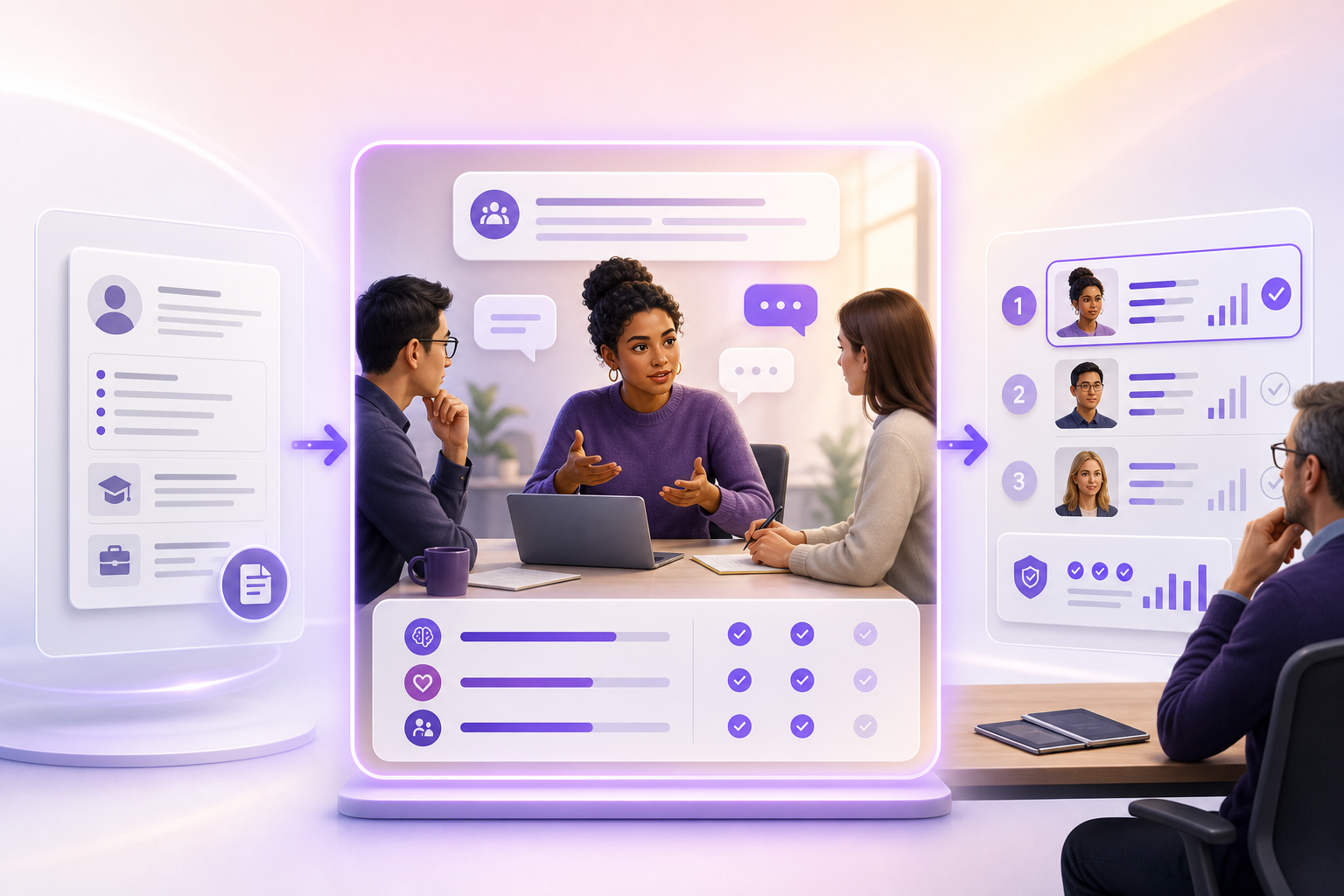
After you qualify, see how they use all 44 soft skills as they do the job. Rank on what they wrote, made, and handed off. Hiring managers get evidence they can compare. The live interview stays. The personality questionnaire goes.
Books, podcasts, and videos
If you want to learn more about why personality tests cause problems in hiring, this list can help. Books, essays, and podcasts on the history, the hype, and what better hiring looks like. Pick whatever format suits you.
Books, podcasts, and videos on personality tests at work
Grant, Bock, Cain, O'Neil, Paul, WorkLife, and Scientific American.
- Annie Murphy Paul, The Cult of Personality Testing (2004) (Book). History of how quizzes moved from clinics into offices, and what gets lost in the move.
- Laszlo Bock, Work Rules! (2015) (Book). Google's former people ops lead on dropping brainteasers and unstructured gut feel. Data over folklore.
- Susan Cain, Quiet (2012) (Book). How extraversion became the default 'good colleague' in hiring rooms.
- Cathy O'Neil, Weapons of Math Destruction (2016) (Book). What happens when a score looks precise and nobody can challenge it.
- Adam Grant, 'Goodbye to MBTI, the Fad That Won't Die' (2013) (Essay). Wharton professor, Fortune 100 usage, and why types fail as science. Start here.
- WorkLife with Adam Grant, 'Your Hidden Personality' (Podcast). Self-report vs watching people work. You would not ask someone how smart they are. You would watch them solve a problem.
- Scientific American, 'Psychological Testing on the Job Market' (Article). Plain explainer: Big Five has some signal. MBTI almost none for job performance. Candidates rate tests as less fair than work samples.
Related WiseWorld research
Cheat-proof assessment, six funnel gaps, AI soft skills tools comparison, pre-interview guide, HireVue alternative, and assess after AI resume.
- Cheat-proof soft skills assessment research
- Six hiring funnel gaps
- Best AI soft skills assessment tools (2026)
- Pre-interview behavioral assessment guide
- HireVue alternative
- Assess candidates after AI resume screening
Frequently asked questions
Common questions about personality test alternatives for hiring
Accuracy, faking, Myers-Briggs, why companies still use quizzes, and what to run instead.
- What is a personality test alternative for hiring? A method that shows how candidates use soft skills as they do the job, after you qualify them on the resume. Structured interviews, simulations, and work from the role all beat a trait questionnaire.
- Are personality tests accurate for hiring? They are weak predictors of job performance. Sackett et al. (2022) put generic personality measures around 0.19, tied with unstructured interviews. Conscientiousness is the least-bad trait in older Big Five work (Barrick and Mount, 1991), and that signal shrinks when applicants can fake (Birkeland et al., 2006).
- Why do companies still use personality tests? They are fast, cheap, and produce a chart managers can discuss. Licenses are already paid. Familiar is not the same as predictive.
- Can candidates cheat a personality test? They can tilt answers toward the 'ideal employee.' Coaching sites and ChatGPT now generate those answers in one paste. There is no private answer key when the items are public.
- Is Myers-Briggs OK for hiring? No. About half of people change at least one letter on a short retest. The publisher has long said it is not a selection tool. Use it for a team workshop if you must. Do not use it to reject someone.
- What should I use instead of a personality quiz? After qualification, send work from the job description. Rank on what they did. Keep a live interview for the people who showed up with evidence.
Methodology and sources
This is a synthesis, not a new survey. Validity bars use Sackett et al. (2022) on the same 0-to-100 index as our other recruitment posts. Faking effects are Birkeland et al. (2006). Adoption is SHRM. Candidate favourability is IJSA (2025). Forum charts score how often a theme appeared in posts we read, 0 to 100. That is not a representative poll.
We did not run Predictive Index, SHL OPQ, or MBTI on a 2026 candidate panel. Vendor manuals often study incumbents, not applicants under incentive. Independent meta-analyses are the fair comparison across methods.
More in Recruitment
Latest on the blog