Case study
Corporate pilot: Soft skills training with 80 programmers
By WiseWorldCorporate pilot, 80 engineers, 3 months

A three-month WiseWorld pilot inside an engineering team put soft skills into the hands of 80 programmers, five minutes a day, no workshops, no homework. Here's what the data tells us about engagement, the skills that came up, and what made it stick.
Of baseline expectation
Still active in final month
No workshops scheduled
Across 6 dimensions
The team & the friction
An engineering team that ships fast, collaborates across functions, and was tired of one-and-done workshops. The brief was simple: improve how they worked together without disrupting sprints or adding recurring meetings.
Team setup
- 80 engineers
- Cross-functional dependencies
- Fast sprint cycles
The friction
- Limited meeting time
- Constant context switching
- Hard to sustain training
The brief
- Build a habit, not an event
- Short, frequent practice
- Measurable progress
Same calendars. Same sprint pressure. One shared experiment in growing without a workshop.
What had been tried
Workshops had given a burst of energy and almost no lasting practice. Skills faded within weeks, there were no measurable outcomes, and appetite for the next round was low. So we tested the opposite shape: short, daily, self-paced.
The old way
Two intense days, then silence.
- 1–2 day events, packed and exhausting
- Skills faded within weeks
- No measurable outcome
- Low appetite for the next round
The bet
Five minutes. Every weekday. For three months.
- 5-minute AI scenarios slotted into the workday
- Self-paced - no new meetings, no homework
- Goal-based learning paths per person
- Activity tracked across 44 skill dimensions
The bet, designed
A three-month program of weekday micro-practice (~5 minutes per day), targeting 44 soft-skill dimensions across 6 main categories. Two things to lock down before the data arrives: how it's designed, and how we'll know it worked.
Design
- FrequencyWeekdays, self-paced
- ModalityAI real-life episodes
- PersonalizationGoal-based paths
Measurement
- ActivityDialogues completed
- RetentionFinal-month activity
- ProgressPath completions
What people chose to work on
Given the choice, half chose growth at work and a third chose something more personal. The split says a lot about what people actually want from soft-skills practice when nobody is assigning it.
Career & work growth
Leadership, tricky situations, visionary thinking, career development
Personal life
Feeling calmer, more confident, better focus, work-life balance
Connection
Social skills, deeper conversations, teamwork, communication
Skills that rose to the top
Out of 44 available skills, six rose to the top - the everyday muscles of working with humans: how to listen, decide, speak up, and bounce back.
Active listening
Communication
Public interaction
Communication
Confidence
Leadership
Decision making
Problem solving
Time management
Work ethic
Resilience
Work ethic
Notice what's missing: nobody asked for personality overhauls. They wanted small, specific, daily-life skills.
Show-up & output
Daily activity held near 47% across the full window. By month three, 83% of the team was still active. Together it added up to ~400 hours of practice and learning-path completion at nearly three times the baseline.
Active on a typical weekday. Steady, not a spike.
Active in the final month - when most courses lose people in week two.
Across 80 people. Zero workshops scheduled.
The quiet rhythm that did the work.
Average breadth covered.
Nearly three times the typical rate - not from pressure, but from a format people could actually keep up with.
When people got stuck
During the episodes, participants could ask Wise, the AI soft-skills coach, for a hint. They did so 2,396 times over three months - about 30 per person. A safety net, not a teacher.
≈ 30 hints per person across 12 weeks
What the number means
People want to figure things out themselves - but they want help available when they need it.
Not a teacher hovering over their shoulder. A safety net that catches them only if they reach for it.
What managers saw
Soft skills used to be the hardest thing to talk about in a review. With the team PowerWheel, managers finally had a picture - a shared view of progress across all 44 skills.
Vague feedback became data.
“Be a better communicator” became a tracked, visible skill.
Team strengths became shared.
Managers could see where the team was thin - and where it had grown.
Bias dropped. Signal rose.
An unbiased view of progress, refreshed in real time.
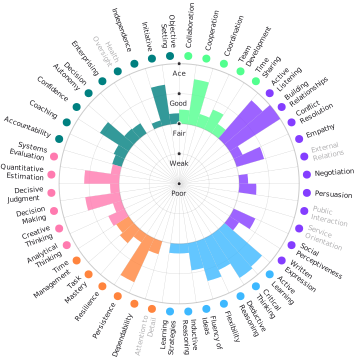
Team coverage - sample of 8 skills (0–100)
Three rules for the next team
Three rules turned a tired format into a habit people kept - and the data backs each one.
Keep it short.
Five minutes survives a sprint. Fifty doesn't.
Daily activity ≈ 47%
Let people choose.
Goal-based paths beat one-size-fits-all every time.
Goals split 50 / 32 / 18
Make progress visible.
People keep going when they can see themselves move.
Completion: 297% of baseline
The bottom line
Engineers will invest in growth. They just won't invest in workshops that disappear the moment they end.
engineers
minutes a day
stayed the course
of baseline