Field report
The Soft Skills Investigation: What 70 team leads told us
By WiseWorldField report - ~70 team leads
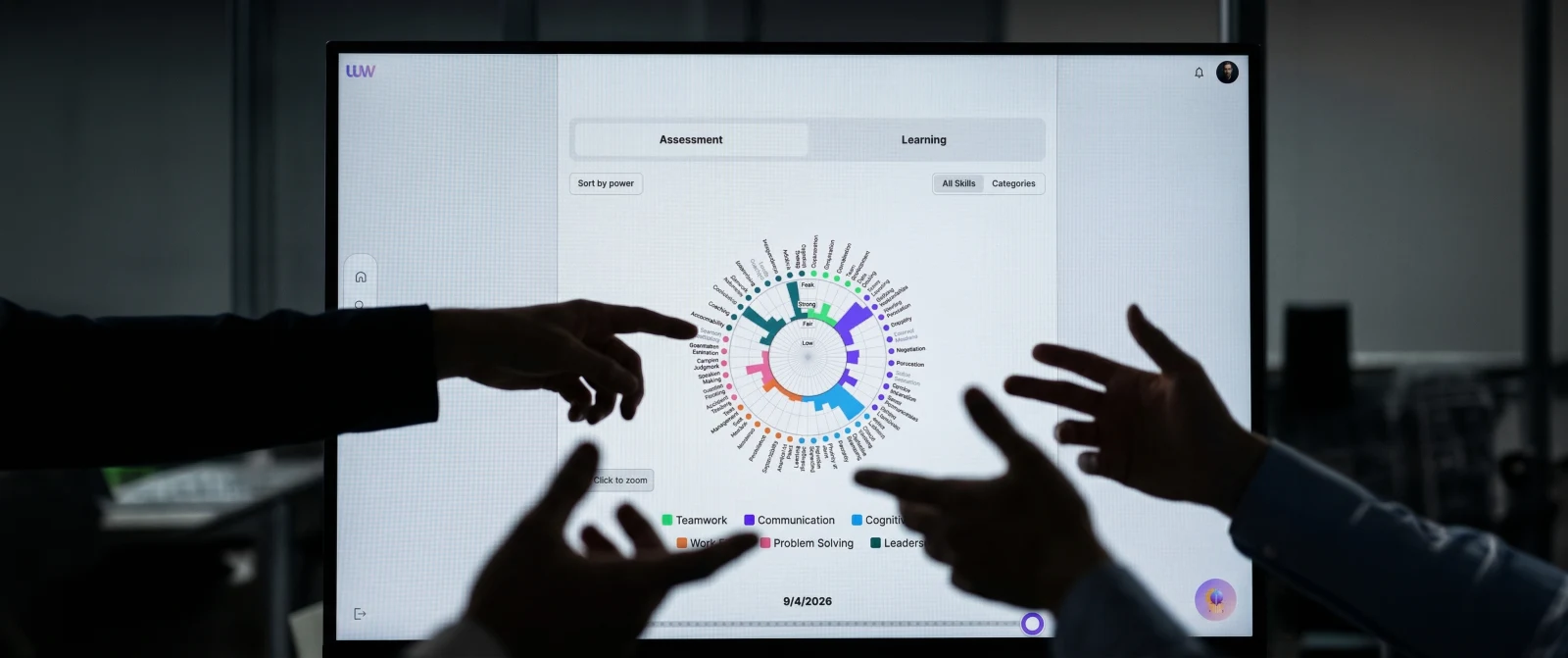
A reporter's notebook from ~70 conversations with team leads across 12+ industries - the way they assess soft skills today, the five gaps that came up almost every time, and what's quietly working for the leaders who are happy.
Across roles and seniorities
Tech, banking, logistics, CX, more
No framework underneath
Named measurement as #1 gap
The assignment
The question we wanted to answer
How do real team leads, across industries and team sizes, actually manage the soft skills that matter most to their team - and where does it break down?
Soft skills are the most-discussed and least-measured part of modern people management. We wanted to map the gap from the inside, in leaders' own words, before assuming what tooling would help.
Three questions, asked the same way every time
Question 01
How do you assess the soft skills of your team?
Question 02
How do you help your team grow them?
Question 03
What's missing?
What we found
The same pattern came back, almost regardless of industry, team size, or remote/hybrid mix. Three findings, in plain terms:
The most-used measurement tool is a feeling. ~40% of leaders run on intuition.
Five gaps repeat seventy times - most leaders named at least one, many named all five.
Where it works, it's the same recipe: real challenges, coaching, and frequency over formality.
Confidence in soft skills judgment was inversely correlated with visibility into the team.
The next sections walk through how each finding showed up in the conversations.
All quotes and percentages in this report are aggregated and anonymized across the ~70 interviews.
Who actually answered
A genuinely mixed sample - not a single industry, a single size, or a single way of working. The pattern we found held up across all of it.
Team leads interviewed
Team-size range
Industries covered
Partly or fully remote
Why the spread matters: tech, banking, logistics, customer experience, consulting, retail, more. Squads of five and departments of two hundred. The findings below repeated across all of them.
When the measurement tool is a feeling
Across all ~70 interviews, the dominant method for assessing soft skills wasn't a framework, a survey, or a tool. It was intuition. “Common sense.” “Through my ears.”
Reporter's note
~40%of leaders said their primary method of judging soft skills is intuition or observation, with no framework underneath it.
Why this matters. Promotions, project assignments, and who gets coached all flow from these assessments. If the input is a feeling, the output is a feeling-driven decision - at scale, with consequences for careers.
It's not because leaders don't care. It's because nothing better has been put in their hands.
How leaders described the toolkit they have today
Intuition & common sense
The dominant primary method - no framework underneath.
1:1 meetings
Regular conversations, weekly to monthly.
Day-to-day observation
Watching behaviour in context, often informal.
360 / performance reviews
Annual or bi-annual cycles, often dreaded.
Workshops & courses
Udemy, LinkedIn Learning, occasional in-person training.
Structured framework
Almost nobody had a real, shared instrument.
Five problems, repeated seventy times
When we asked what was missing, the same gaps came up across industries and team sizes. Almost every leader named at least one. Many named all five.
Problem 1 of 5
I can feel they're improving. I can't show it.
42% named measurement as their single biggest gap
Leaders sensed people were getting better at communication, collaboration, and feedback - but had no way to prove it. No baseline. No trend line. No way to demonstrate to themselves, to HR, or to the person being coached that the work was paying off.
“I can feel they're improving. I can't show it.”
- Engineering manager, 15-person team
“What's missing is track and measurement. We need visual, systematic, analytic insights.”
- VP, 15-person team
“I need data to support my feedback. When someone is not humble to receive feedback, I have nothing concrete to show.”
- Team lead, 4-person team
Problem 2 of 5
Feedback is the part everyone puts off until they can't.
35% flagged feedback itself as the part that breaks down
Writing it, giving it, receiving it - this was the cycle leaders said failed most often. Reviews ate hours of real work. Honesty felt risky without data behind it. And recency bias kept overwriting six months of context with the last two weeks.
Writing reviews is slow
Hours per cycle, pulled from real work.
Honesty feels risky
Without data, it sounds like an opinion.
Recency bias dominates
The last two weeks override the last six months.
“Writing about their performance is time-consuming. It's super hard to do this process.”
- Team lead, 8-person team
“People hate to provide feedback. They procrastinate. It's time-consuming for everyone.”
- Engineering manager
“The SWOT analysis in 360 format - it's slow and time-consuming.”
- Tech team lead
Problem 3 of 5
Leaders know their assessments are biased. Knowing doesn't fix it.
~25% volunteered, unprompted, that they don't fully trust their own evaluations
Recency bias. Halo effects. Quiet team members marked down for "communication" simply because they spoke less in meetings. Leaders named the bias clearly - and then admitted there was nothing in their toolkit that could neutralise it.
Recency bias
The last conversation outweighs the last quarter.
Halo bias
Strong on one skill, assumed strong on the rest.
Visibility bias
Loud voices read as confident; quiet ones, as uncertain.
“The approach is common sense, which means it's biased.”
- Team lead, 15-person team
“The challenge is to really understand if what they are saying is genuine or they're gaming the system.”
- Manager, 11-person team
“I assess them through my ears.”
- Customer experience lead, 12 reports
Problem 4 of 5
Remote work thinned out the signals. Nothing replaced them.
Most teams were partly or fully remote
Body language, hallway moments, unscripted reactions under pressure - the unstructured signals leaders had relied on for years. A handful mentioned async written feedback or video review. Most said they were assessing 2024 problems with 2019 instincts.
What remote removed
Body language, hallway chats, watching people handle pressure in real time.
What replaced it
Mostly nothing - a few async feedback or video-review experiments, no shared standard.
“In a remote setting, relationships happen through a glass. We miss information. We can't read between the lines.”
- Director, 125-person team
“In remote setup, it's much more challenging to know people.”
- Lead, growing team
“We're fully remote with team members around the world. Direct conversation is all I have.”
- Lead, 10-person global team
Problem 5 of 5
When the manager leaves, the data leaves with them.
12% raised this on their own - but it's the answer to a much bigger question
Years of context - who handles conflict well, who's ready to lead, who needs more structure - sat in one person's head. When that person moved on, the next manager started from zero. Every transition quietly erased institutional memory the company never realised it had.
“All the information stays with the manager. It should belong to the company.”
- Tech lead
“When managers leave, the soft skills data goes with them. The next person starts from zero.”
- Engineering manager
“I want to leave some data for successors. Right now, it all disappears.”
- Lead, 10-person remote team
The confident outliers
A small group said nothing was missing. They stood out enough to deserve their own paragraph.
A reporter's observation
~7%
said nothing was missing.
- Often the most senior
- Often managing the largest teams
- Often admitting in the same breath that they didn't have time for regular 1:1s
The pattern
Confidence in soft skills judgment was inversely correlated with the visibility a leader had into their team.
The less they tracked, the more sure they were. The leaders furthest from the data felt the most certain about it - a quiet warning sign for any organisation relying on senior instinct alone.
What leaders want next
When we asked what would actually help, leaders consistently described the same shortlist. None of it was glamorous. All of it was specific.
Personalized paths
Not one-size-fits-all training
“Have a profile of each individual. Give organic suggestions for them.”
Data-driven insights
Objective evidence for feedback
“Turn these skills into data. Give me something concrete.”
Engaging tools
High adoption and participation
“Something that is not boring. Something people actually want to use.”
Practice with feedback
Not just theory, but application
“Something that people can practice and get feedback on.”
Progress tracking
See development over time
“Visual and systematic. Analytic insights I can act on.”
Real scenarios
Safe space to practice
“Live scenarios. Role playing. Preparation for real interactions.”
Where HR sits in the picture
When asked about HR's role specifically, leaders described a gap between what was needed and what was provided. Tools existed, but rarely felt useful at the team level.
- HR provides tools, but they're not very useful
- We're autonomous - HR doesn't support this
- HR focuses on resources, not humans
- HR makes things standardized but impersonal
“HR is more focused on resource than human.”
- Manager, banking sector
“Some tools from HR are not very useful and are only formality.”
- Team lead, 10-person team
“I don't need their support. I use my psychology knowledge.”
- Lead, 6-person team
The bottom line
Soft skills are the most important, most discussed, and least measured part of modern people management.
~70 leaders described the same problem in their own words. Almost none had a real solution. Instinct got them this far. The next decade - flatter teams, remote-first work, faster turnover - will ask for something more.
Everyone struggles
Across industries, sizes, and remote/hybrid mixes - the same five gaps came up.
Current tools fall short
360s are slow. Workshops are forgotten. Intuition is biased - and leaders know it.
Leaders want better
Objective data, personalization, and continuous tracking - not annual rituals.
Methodology
How we gathered these insights from team leads across industries.
Aggregated and anonymized
Tech, banking, logistics, CX, consulting, retail, more
From small squads to large departments
Most teams partly or fully distributed
Engineering managers, directors, VPs
Three open questions, anonymized findings
Names and company identifiers have been removed. All quotes and percentages are aggregated and anonymized.
What's next
WiseWorld is built for what these leaders asked for: structured, personalized, data-driven soft skills practice - with the frequency and visibility their current toolkit can't deliver.